One of the greats of folk music passed last night.
Seeger is one of those guys (like Woody Guthrie) who wrote all sorts of songs that I heard while growing up without knowing who the songwriter was.
Anyhow, here's a link to an interview he gave to Terry Gross on NPR way back in 1985 (yes, Terry Gross has been on NPR a long time!)
Tuesday, January 28, 2014

Tuesday, January 14, 2014
Three hours wasted
I should have just seen Catching Fire for a second time.
Instead, I decided that, in spite of my misgivings, I should give The Wolf of Wall Street a try. Because Scorsese. I mean, it couldn't be as dreadful as it looked, could it?
But it was. Three hours of sociopaths, making money by pushing junk stocks on suckers, doing tons of drugs, having orgies, having affairs, driving while on drugs, flying a helicopter while (chemically) high, etc.
I don't know what the point is supposed to be.
Instead, I decided that, in spite of my misgivings, I should give The Wolf of Wall Street a try. Because Scorsese. I mean, it couldn't be as dreadful as it looked, could it?
But it was. Three hours of sociopaths, making money by pushing junk stocks on suckers, doing tons of drugs, having orgies, having affairs, driving while on drugs, flying a helicopter while (chemically) high, etc.
I don't know what the point is supposed to be.
Monday, January 06, 2014
The Girl Who Played with Catching Fire
So Part II of the Hunger Games Trilogy is in the theaters, and it's breaking records. (Well, it's kind of a trilogy and kind of isn't, since there are three books, but the third book will be separated into two films. Which isn't that unreasonable, when you consider that The Hobbit is being split into three different films.)
The Hunger Games Trilogy is ground-breaking in that it features a female lead. We've had dozens of trilogies, of all sorts of types of stories, but I'm pretty sure this is the first time Hollywood has had a franchise of this sort whose main character is female. It isn't, however, the first trilogy with a female lead. Well, not really. That depends on who you think is the lead of the Lisbeth Salander trilogy: Salander or Blomkvist. That I refer to the trilogy as the "Salander trilogy" should make my position clear.
That Hollywood gives women few opportunities like this is hardly news. But I would argue that women have been losing ground in the past decade or so. In the 70s and 80s there were many films created around strong leading actresses like Ellen Burstyn, Meryl Streep, Jessica Lange, Glenn Close, Sissy Spacek, Jodie Foster, etc. I really have to wonder whether a film like The Accused could be made in today's Hollywood.
Consider what our most talented young actresses are doing: Natalie Portman is Thor's girlfriend, Kate Winslet did Mildred Pierce for HBO, and Michelle Williams is stuck doing indy films. Ellen Page is nowhere to be seen (update: she's back as Kitty Pryde in the next X-Men film) and Anna Kendrick is playing a college frosh again in Pitch Perfect. (I guess 27 is the new 18.) I'm hoping Jennifer Lawrence can break this pattern.
Hollywood has become very formulaic in terms of which genres will be represented in film. There are the tentpole blockbusters, which in recent years are mostly action films and their several sequels. The current trend is for comic book hero films, but there are still other franchises (Pirates of the Carribean comes to mind, though that particular one is done.) There are animated G-rated features, which tend to have very simplistic plots (far more simplistic than 'G' requires, but I digress). There are "rom coms", romantic comedies which themselves tend to a small number of formulas aimed at teenagers. Then there are horror films, which tend to be low budget (since return is unpredictable) and what I would call "Oscar Bait", the handful of films that are released in December that do not do well in the box office but rake in the nominations for the various award shows. Recent examples include The King's Speech (dull) and The Artist (flimsy).
See the 2012 box office leaders for example. The top two films were comic book adaptations, as with #7. We have other franchises at 3, 4, 5, and 6, and animated kids' films are at 8, 10, 11, 12. Seth McFarlane's Ted is the only exception, but even Ted has plenty of animation (though it's hardly a kids' film).
The collapse of Hollywood's products into these pre-defined genres has meant that high quality video entertainment is largely relegated to the various cable networks. There seems to be a working presumption by film executives that moviegoers only want to see the same thing, over and over. There are even people in the field of "Big Data" working for Hollywood, telling them what "elements" a film needs to have to make money. The NY Times decsribes this kind of consultant. Apparently bowling scenes are bad for business.
Here's another discussion of this phenomenon. In this case, the focus is on a guy named Nick Meaney, and his company, Epagogix. My take-home quote here is
And we're supposed to believe this has nothing to do with pre-conceptions, or the male domination of the board rooms.
So, back to the top: what can we hope for these two?

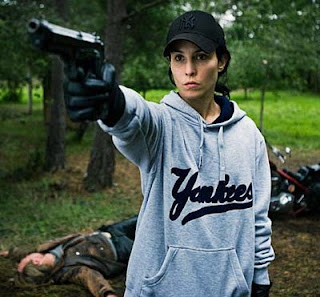
The parallel that struck me here was not only that they are in trilogies, but both of their middle volumes treat with fire. Lisbeth's second film was "The Girl Who Played with Fire", and Katniss's is "Catching Fire".
So what is my general point here? It's that people claiming to "analyze" public preferences may be doing far less than they claim to be doing. That sexism persists in Hollywood and in society at large. There is no other way to explain how actresses are consistently cast aside when they hit 30, while actors can stick around for decades, even as romantic leads with increasingly improbable younger female partners on screen. (Michael Douglas is a great example here: in one four-film sequence in the early 90s he went from Kathleen Turner (b. 1954) to Melanie Griffith (b. 1957) to Sharon Stone (b. 1958) to Demi Moore (b. 1962). And of course he's married to Catherine Zeta-Jones, b. 1969).
To get better roles for women in film, we need to get better roles for women in the society at large. The triumphs of Katniss Everdeen and Lisbeth Salander are hopefully a step along this path. But I'm less optimistic than I might be.
The Hunger Games Trilogy is ground-breaking in that it features a female lead. We've had dozens of trilogies, of all sorts of types of stories, but I'm pretty sure this is the first time Hollywood has had a franchise of this sort whose main character is female. It isn't, however, the first trilogy with a female lead. Well, not really. That depends on who you think is the lead of the Lisbeth Salander trilogy: Salander or Blomkvist. That I refer to the trilogy as the "Salander trilogy" should make my position clear.
That Hollywood gives women few opportunities like this is hardly news. But I would argue that women have been losing ground in the past decade or so. In the 70s and 80s there were many films created around strong leading actresses like Ellen Burstyn, Meryl Streep, Jessica Lange, Glenn Close, Sissy Spacek, Jodie Foster, etc. I really have to wonder whether a film like The Accused could be made in today's Hollywood.
Consider what our most talented young actresses are doing: Natalie Portman is Thor's girlfriend, Kate Winslet did Mildred Pierce for HBO, and Michelle Williams is stuck doing indy films. Ellen Page is nowhere to be seen (update: she's back as Kitty Pryde in the next X-Men film) and Anna Kendrick is playing a college frosh again in Pitch Perfect. (I guess 27 is the new 18.) I'm hoping Jennifer Lawrence can break this pattern.
Hollywood has become very formulaic in terms of which genres will be represented in film. There are the tentpole blockbusters, which in recent years are mostly action films and their several sequels. The current trend is for comic book hero films, but there are still other franchises (Pirates of the Carribean comes to mind, though that particular one is done.) There are animated G-rated features, which tend to have very simplistic plots (far more simplistic than 'G' requires, but I digress). There are "rom coms", romantic comedies which themselves tend to a small number of formulas aimed at teenagers. Then there are horror films, which tend to be low budget (since return is unpredictable) and what I would call "Oscar Bait", the handful of films that are released in December that do not do well in the box office but rake in the nominations for the various award shows. Recent examples include The King's Speech (dull) and The Artist (flimsy).
See the 2012 box office leaders for example. The top two films were comic book adaptations, as with #7. We have other franchises at 3, 4, 5, and 6, and animated kids' films are at 8, 10, 11, 12. Seth McFarlane's Ted is the only exception, but even Ted has plenty of animation (though it's hardly a kids' film).
The collapse of Hollywood's products into these pre-defined genres has meant that high quality video entertainment is largely relegated to the various cable networks. There seems to be a working presumption by film executives that moviegoers only want to see the same thing, over and over. There are even people in the field of "Big Data" working for Hollywood, telling them what "elements" a film needs to have to make money. The NY Times decsribes this kind of consultant. Apparently bowling scenes are bad for business.
Here's another discussion of this phenomenon. In this case, the focus is on a guy named Nick Meaney, and his company, Epagogix. My take-home quote here is
"One of the heads of the studio laughed and said, 'Oh that’s great! You’ve just saved me $12 million!'" says Meaney, recounting the conversation. "And we said, 'How so?' And he said, 'The person I had in mind for the female lead was Ms. X,' a very well known Hollywood actress, 'and you’re saying that role doesn’t need to be as big as it was, so we don’t need her.'"So that's what's happened to Nicole Kidman. A computer geek told a Hollywood executive that women are fungible. (I don't know that he's referring specifically to Kidman, but he could be.)
And we're supposed to believe this has nothing to do with pre-conceptions, or the male domination of the board rooms.
So, back to the top: what can we hope for these two?


The parallel that struck me here was not only that they are in trilogies, but both of their middle volumes treat with fire. Lisbeth's second film was "The Girl Who Played with Fire", and Katniss's is "Catching Fire".
The success of these series shows that the "analysis" of the number crunchers above provides little in terms of true predictive beyond the maxim from statistics: garbage in, garbage out. When film executives consistently cast women only in secondary roles, they not only neglect opportunities for women, they also shape the expectations of the public. And while the producers defend this practice by saying that their formulas predict what the audiences, I think it's clear that the audience also wants interesting stories, and to be occasionally surprised. Perhaps this decade is more ready for a lead actress like Jennifer Lawrence than the 1990s were. But I would argue that the history of action films with female leads is that these series have historically either used dreadful leads with little talent (Tanya Roberts?) or entailed scripts that simply tried to ignore the gender of the lead (the nonsense that Renny Harlin and Geena Roberts did in the '90s).
So what is my general point here? It's that people claiming to "analyze" public preferences may be doing far less than they claim to be doing. That sexism persists in Hollywood and in society at large. There is no other way to explain how actresses are consistently cast aside when they hit 30, while actors can stick around for decades, even as romantic leads with increasingly improbable younger female partners on screen. (Michael Douglas is a great example here: in one four-film sequence in the early 90s he went from Kathleen Turner (b. 1954) to Melanie Griffith (b. 1957) to Sharon Stone (b. 1958) to Demi Moore (b. 1962). And of course he's married to Catherine Zeta-Jones, b. 1969).
To get better roles for women in film, we need to get better roles for women in the society at large. The triumphs of Katniss Everdeen and Lisbeth Salander are hopefully a step along this path. But I'm less optimistic than I might be.
Thursday, October 24, 2013
Agents of S.H.I.E.L.D.? Not getting into it
OK, I've watched five episodes now and it's not really holding my interest. Part of it is the story structure, but a good deal of it is the casting.
The basic frame is that there's a young hacker woman named Skye who is brought in to work with Agent Coulson's group. Chloe Bennet as Skye is a typical Joss Whedon heroine: independent, self-directed, confident. And she's good at her rule, even though her resemblance to another Whedon stalwart, Eliza Dushku, is noteworthy. She's got the Buffy/River role.
And of course Clark Gregg as Agent Coulson is very good. He's continuing the role he started in the Iron Man films, even though he supposedly died in The Avengers film. (The in-show explanation is that the death was faked by Nick Fury to motivate the Avengers, but there are hints that there's a lot more to that story.) Gregg is a very strong ensemble actor and does well here. I don't know if he could carry a show himself. But he doesn't have to.
Ming-Na Wen is strong as the supporting super-warrior Melinda May, like Zoe in Serentiy. Hasn't had quite enough to work with, since Skye is the main character. But I like when she's on screen.
But it goes down from there.
The lead male character is Grant Ward, played by Brett Dalton. He's dreadful. He's one of these generic Hollywood pretty boys who doesn't bring enough grit to an action role. Very much in the Ryan Gosling pattern. He's no Mal. He's boring. He can't get off screen fast enough. That's a huge problem, since essentially he's the lead of the series. Why is Hollywood so intent on giving lead parts based on looks? Models cannot carry TV shows. They've never been able to do that.
Aside from that are Dr. Fitz and Dr. Simmons, collectively referred to as "FitzSimmons". Clever enough. The actors are Iain De Caestecker as Leo Fitz and Elizabeth Henstridge as Jemma Simmons.
I don't think anybody in science is named "Jemma". I digress.
These two might develop into stronger characters, but so far they are mostly comic relief, with an occasional dash of technical wizardry.
Hopefully things pick up. If not, this series is not going to survive very long. Production costs are too high for the show to get away with being boring. My suggestion? Get rid of Grant Ward. And one annoying thing that has been going on is that the show cannot resolve the question of whether Skye is 100% with S.H.I.E.L.D. or whether she's still working with the anarchist group Rising Tide.
Hoping that this becomes more compelling. At least it looks better than Under the Dome.
11/8 update
Update: OK, the 6th episode was much better than the most recent few episodes. Less Skye, more FitzSimmons, all the characters were humanized a bit.
Joss just bought a little more time with this one.
The basic frame is that there's a young hacker woman named Skye who is brought in to work with Agent Coulson's group. Chloe Bennet as Skye is a typical Joss Whedon heroine: independent, self-directed, confident. And she's good at her rule, even though her resemblance to another Whedon stalwart, Eliza Dushku, is noteworthy. She's got the Buffy/River role.
And of course Clark Gregg as Agent Coulson is very good. He's continuing the role he started in the Iron Man films, even though he supposedly died in The Avengers film. (The in-show explanation is that the death was faked by Nick Fury to motivate the Avengers, but there are hints that there's a lot more to that story.) Gregg is a very strong ensemble actor and does well here. I don't know if he could carry a show himself. But he doesn't have to.
Ming-Na Wen is strong as the supporting super-warrior Melinda May, like Zoe in Serentiy. Hasn't had quite enough to work with, since Skye is the main character. But I like when she's on screen.
But it goes down from there.
The lead male character is Grant Ward, played by Brett Dalton. He's dreadful. He's one of these generic Hollywood pretty boys who doesn't bring enough grit to an action role. Very much in the Ryan Gosling pattern. He's no Mal. He's boring. He can't get off screen fast enough. That's a huge problem, since essentially he's the lead of the series. Why is Hollywood so intent on giving lead parts based on looks? Models cannot carry TV shows. They've never been able to do that.
Aside from that are Dr. Fitz and Dr. Simmons, collectively referred to as "FitzSimmons". Clever enough. The actors are Iain De Caestecker as Leo Fitz and Elizabeth Henstridge as Jemma Simmons.
I don't think anybody in science is named "Jemma". I digress.
These two might develop into stronger characters, but so far they are mostly comic relief, with an occasional dash of technical wizardry.
Hopefully things pick up. If not, this series is not going to survive very long. Production costs are too high for the show to get away with being boring. My suggestion? Get rid of Grant Ward. And one annoying thing that has been going on is that the show cannot resolve the question of whether Skye is 100% with S.H.I.E.L.D. or whether she's still working with the anarchist group Rising Tide.
Hoping that this becomes more compelling. At least it looks better than Under the Dome.
11/8 update
Update: OK, the 6th episode was much better than the most recent few episodes. Less Skye, more FitzSimmons, all the characters were humanized a bit.
Joss just bought a little more time with this one.
Wednesday, October 02, 2013
The Progressive Wish List
As Greg Sargent points out, there is a fundamental lack of symmetry in what the two parties in DC are saying needs to be done in order to end the government shutdown. The Republicans have passed a list of demands of concessions they want from the Democrats before they are willing tot let the government continue to exist on regular terms. The Democrats have not presented a similar list of demands. They have simply put forward the proposition that the Republicans must stop acting like children and/or terrorists.
It's time for Progressives to fight back with a list of our own. More after the jump.
It's time for Progressives to fight back with a list of our own. More after the jump.
Friday, September 20, 2013
Universities are cash cows
Some quick facts:
In 1981, room and board at Harvard Universirty for an undergrad cost $9170.
(source: http://vpf-web.harvard.edu/budget/factbook/00-01/page23.html)
In 2012, room and board at Harvard Univeresity for an undergrad cost $54,496. (source: http://harvardmagazine.com/2012/03/harvard-college-tuition-financial-aid-increase-2012)
Using inflation calculator at www.usinflationcalculator.com, the total amount of inflation from 1981 to 2012 was 152.6%. That means (using their calculator), something that cost $9170 in 1981 should have cost $23,161 in 2012. It's true that not all costs rise at the same rate, but it's not like the base costs of a university are all that different from what the costs are in general for a university. It's not a highly specialized market like gold or microchips
One more comparison:
In 1981, the endowment of Harvard University was $1.622 billion.
(source: http://www.provost.harvard.edu/institutional_research/harvard_fact_book_2012_endowment.pdf)
In 2012, the endowment of Harvard University, after a bad year, shrank to $30.7 million.
(source: http://harvardmagazine.com/2012/09/harvard-endowment-declines-to-30-7-billion)
Again, using the calculator, a fixed investment growing at the rate of inflation in 1981, starting at $1.622 billion should be at about $4.1 billion. Now of course we expect investments to outpace inflation. And that explains part of how the endowment grew faster than inflation. But also, we need to account for the continued new donations to the endowment.
But all of this gets us back to the basic point here. The Harvard endowment is growing at a pace far outstripping the rate of inflation. But in spite of that, the cost of tuition (and room and board) is also growing at a pace far outstripping the rate of inflation.
Something is seriously messed up here. Universities like Harvard are simply becoming huge depositories for cash. Its endowment has taken on a life of its own, completely untethered to covering the costs of running a university.
In 1981, room and board at Harvard Universirty for an undergrad cost $9170.
(source: http://vpf-web.harvard.edu/budget/factbook/00-01/page23.html)
In 2012, room and board at Harvard Univeresity for an undergrad cost $54,496. (source: http://harvardmagazine.com/2012/03/harvard-college-tuition-financial-aid-increase-2012)
Using inflation calculator at www.usinflationcalculator.com, the total amount of inflation from 1981 to 2012 was 152.6%. That means (using their calculator), something that cost $9170 in 1981 should have cost $23,161 in 2012. It's true that not all costs rise at the same rate, but it's not like the base costs of a university are all that different from what the costs are in general for a university. It's not a highly specialized market like gold or microchips
One more comparison:
In 1981, the endowment of Harvard University was $1.622 billion.
(source: http://www.provost.harvard.edu/institutional_research/harvard_fact_book_2012_endowment.pdf)
In 2012, the endowment of Harvard University, after a bad year, shrank to $30.7 million.
(source: http://harvardmagazine.com/2012/09/harvard-endowment-declines-to-30-7-billion)
Again, using the calculator, a fixed investment growing at the rate of inflation in 1981, starting at $1.622 billion should be at about $4.1 billion. Now of course we expect investments to outpace inflation. And that explains part of how the endowment grew faster than inflation. But also, we need to account for the continued new donations to the endowment.
But all of this gets us back to the basic point here. The Harvard endowment is growing at a pace far outstripping the rate of inflation. But in spite of that, the cost of tuition (and room and board) is also growing at a pace far outstripping the rate of inflation.
Something is seriously messed up here. Universities like Harvard are simply becoming huge depositories for cash. Its endowment has taken on a life of its own, completely untethered to covering the costs of running a university.
Sunday, September 15, 2013
Best of Bond IV...Old Bond
Bond, Part IV
This post has been slow in coming, probably in part because these are the dismal years. Let's face it: Roger Moore stayed with the role too long. By the end of his run he was 57 and looking it.So...the late Moore films. A mixed bag - not uniformly bad but only one of the bunch is actually good in my opinion. We last left the series with Moonraker, a film that has not aged well. Then there was For Your Eyes Only, a film that has aged well. And then we have the slow decline into Octopussy and the face plant known as A View to a Kill.
I think when I started this series I may have said that Never Say Never Again would be tucked in with the two Timothy Dalton films. While that would partition the films more evenly, I think it's more natural to throw it in with the Old Roger films, since it was contemporaneous with Octopussy and has many of the same flaws (in addition to its own unique flaw!)
While the previous round of Roger Moore films featured super villains in hidden mega-complexes threatening to destroy the world, the later films eased up a bit on those cliches. Still a lot of gadgets, though. And a lot of camp. Almost no concern for realism.
Let's recall the criteria in this series of evaluations again:
- Bond – who the actor is, how good he is, and what he brings to the role
- the Villain- Mr. Big, Scaramanga, etc. I judge the films on how compelling the villain is.
- the Bond Women – some films have few, some have many, but I’m pretty sure all have at least one. The quality ranges from Denise Richards’s absurd nuclear physicist to, of course, Mrs. Bond herself, not to mention Pussy Galore
- the Good Guys – M, Q, Moneypenny, Felix Leiter in his many incarnations and other sidekicks
- the Henchmen on the other side like Jaws, Oddjob, and Nick-Nack.
- the gadgets – not just judging how neat the gadgets are, but whether they were unwisely allowed to take over the film (as often happened with the later Roger Moore filims)
- whatever else I happen to think of
And now we move to
For Your Eyes Only
Subscribe to:
Posts (Atom)